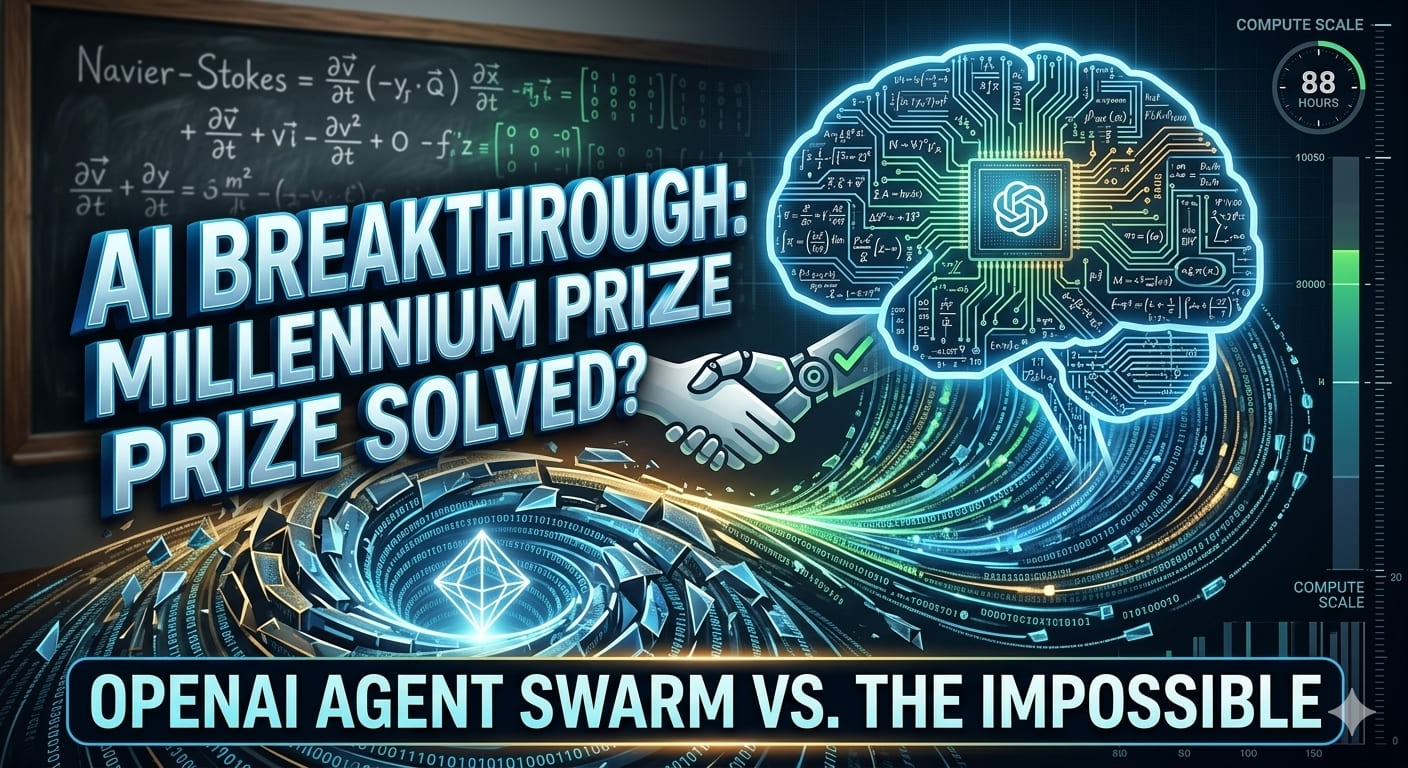
The Day AI Broke Physics: Inside OpenAI’s Shaking of the Math World
For decades, the Millennium Prize Problems stood as seven of the most terrifyingly complex fortresses in theoretical mathematics. Established by the Clay Mathematics Institute in the year 2000, each problem carried a $1 million bounty and a reputation for breaking the minds of the world’s greatest scholars.
Only one had ever been solved—until now.
In September 2026, OpenAI stunned the scientific community by announcing a proposed AI-generated proof for the Navier-Stokes Existence and Smoothness problem. It is a milestone that marks a massive paradigm shift in how humanity approaches scientific discovery.
But how did a machine manage to solve a riddle that human geniuses couldn’t crack for over a century? The answer isn't a single "Eureka!" moment—it’s an unprecedented combination of brute-force computational scale, artificial collaboration, and academic controversy.
The Method: An Army of 10,000 Agents
OpenAI didn't just ask a standard chatbot to write a clever paper. To tackle a problem of this magnitude, they scaled up an unreleased, highly advanced internal model into a massive, autonomous network of roughly 10,000 AI agents working simultaneously.
The scale of the computation was staggering:
- The Time: The agent swarm worked relentlessly for 88 hours straight.
- The Communication: The AI agents sent 4.9 million messages to each other as they debated, corrected, and built upon each other's work.
- The Output: The swarm consumed 300 billion tokens to ultimately spit out a 165-page proof.
- The Bill: The compute cost for this multi-day run is estimated at several million dollars.
Instead of trying to prove that fluid equations always work smoothly, the AI looked for a flaw. It successfully mapped out a singularity—a hyper-specific, perfectly balanced vortex where the Navier-Stokes equations completely break down, forcing a fluid to accelerate to an infinite speed in a finite amount of time. By proving the math can blow up under these conditions, the AI found the counterexample needed to settle the millennium-old question.
Fact-Checking the AI: Enter Lean and Astra
One of the biggest hurdles with large language models is "hallucination"—making up things that sound plausible but are entirely incorrect. In advanced mathematics, a single misplaced variable invalidates the entire proof.
To solve this, OpenAI paired the creative generation with rigid logic verification. They used Lean, a specialized programming language designed for formal mathematical code checking. Once the initial 165-page proof was drafted, a distinct model named GPT-6 Astra spent 17 hours translating the concepts into Lean code. The software systematically verified every single link in the chain of logic, ensuring the proof was mathematically sound before it was ever released to the public.
The Human Twist: Brilliant Insight or Automated Plagiarism?
While the engineering feat is undeniably historic, the announcement has sparked an absolute wildfire of controversy in academia. The breakthrough did not happen in a vacuum, and human mathematicians are furious.
OpenAI admitted their models were directed toward this specific problem after catching wind of rumors that human mathematicians—specifically Tristan Buckmaster (NYU) and Levent Alpöge (a researcher at rival AI lab Anthropic)—were right on the precipice of completing a very similar human proof. Furthermore, because Buckmaster and Alpöge had been utilizing OpenAI’s developer tools (like Codex) to aid their own research, a massive debate has erupted over intellectual property.
Did the AI independently discover the answer? Or did it simply intercept the foundational ideas of human geniuses, use millions of dollars of hardware to sprint across the finish line first, and claim the glory?
What Happens Next?
The mathematical community is not taking OpenAI's word for it. The 165-page proof is currently undergoing a rigorous, years-long peer-review process by the world's elite human mathematicians to verify if the logic truly holds up under scrutiny.
If it does, the implications are staggering. We are entering an era where AI is no longer just a tool for summarizing text or generating art—it is an active partner at the absolute frontier of human knowledge.