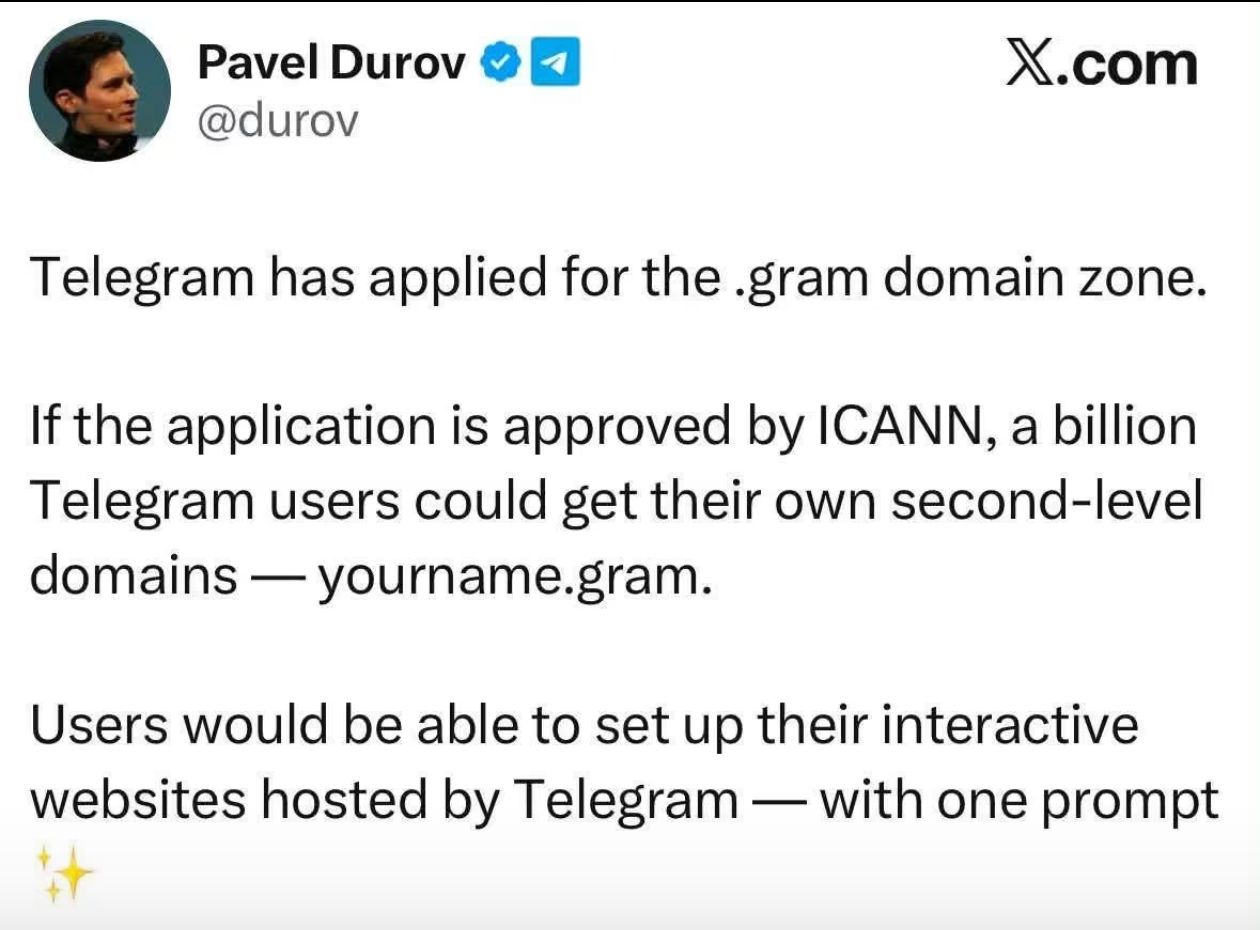
Telegram is exploring a significant expansion beyond messaging. On August 18, 2026, Telegram founder Pavel Durov announced that the company had applied to ICANN for the .gram top-level domain.
If the application is approved, Telegram says its users could eventually receive second-level web addresses based on their Telegram usernames, such as yourname.gram. Durov also described a future in which users could create interactive websites hosted by Telegram using a simple prompt.
The proposal could turn a Telegram username from a messaging identity into something much closer to a web identity.
However, there is an important distinction: Telegram has applied for .gram; the domain has not yet been approved or launched. The final outcome will depend on ICANN's new generic top-level domain application process.
What Is the .gram Domain?
A top-level domain, commonly called a TLD, is the part of a web address that appears after the final dot.
For example:
google.com
uses .com.
wikipedia.org
uses .org.
Telegram is seeking to operate:
.gram
If approved and eventually delegated into the public Domain Name System, .gram could become a dedicated namespace associated with Telegram.
The proposed idea is particularly interesting because Telegram already has a massive username system. Instead of using a username only inside the Telegram application, Telegram could potentially connect that identity to an address such as:
username.gram
That could give users a much simpler way to establish an online presence.
What Did Telegram Actually Announce?
Pavel Durov said that Telegram had applied for the .gram domain zone through ICANN.
According to his announcement, if the application receives approval, Telegram's users could get second-level domains such as yourname.gram.
He also said users would be able to create interactive websites hosted by Telegram using a single prompt.
That second part may ultimately be more important than the domain itself.
A domain name is only an address. The ability to create a functioning website from a natural-language prompt would combine domain identity, hosting and AI-assisted website creation into one platform.
For people without technical knowledge, that could significantly reduce the complexity of launching a website.
Is .gram Already Approved?
No.
This is one of the most important details to understand.
Telegram has announced that it has submitted an application, but an application is not the same thing as an approved top-level domain.
ICANN's 2026 New Generic Top-Level Domain Program opened its application window on April 30, 2026, and closed submissions on August 12, 2026. Applications must go through the relevant evaluation and approval stages before a new TLD can become operational.
Therefore, .gram should currently be described as a proposed Telegram-operated TLD, not as a live domain extension.
There is also no reason to assume that every Telegram user will automatically receive a .gram address until Telegram publishes the final implementation details.
How Could username.gram Work?
The concept is relatively simple.
Today, a Telegram user might have a username such as:
@alex
If Telegram's proposal is implemented as described, the corresponding web identity could potentially become:
alex.gram
That creates an interesting connection between an existing social identity and a web address.
Instead of asking people to search for a username inside Telegram, a person could potentially share a short web address.
For creators, businesses and public figures, that could become a useful way to promote their Telegram presence.
However, it is important not to confuse this with traditional domain ownership.
Would Users Actually Own Their .gram Domains?
Probably not in the same way that someone owns a conventional domain such as example.com.
This distinction matters.
When someone registers a conventional domain, they generally manage it through a registrar. Depending on the domain and registrar, they can renew it, modify DNS settings, transfer it and connect it to different hosting providers.
A Telegram-controlled .gram namespace could work differently.
If Telegram operates the registry and connects .gram addresses to Telegram usernames, the address could remain closely tied to the user's Telegram account and Telegram's rules.
That means questions remain open about what happens if a user changes their username, loses an account or violates platform rules.
Telegram has not yet published enough technical and policy details to answer all of these questions.
So username.gram should be thought of as a potential Telegram-managed web identity, rather than automatically assuming it would function like an independently registered .com domain.
Could Telegram Turn Usernames Into Websites?
This is where the proposal becomes much more interesting.
Telegram already supports a large ecosystem of bots, Mini Apps, channels and other interactive services.
A .gram namespace could potentially give that ecosystem a public web-facing identity.
For example, a creator could potentially have:
creator.gram
A business could have:
business.gram
A community could potentially have:
community.gram
The address could serve as a gateway to information, Telegram functionality and interactive content.
The most ambitious part of Telegram's announcement is the possibility of generating these experiences using a simple prompt.
Instead of manually purchasing hosting, installing a content management system and designing a website, a user could potentially describe the site they want and let Telegram's tools generate it.
That capability has not yet been launched as part of .gram, so it is best understood as part of Telegram's stated vision rather than an immediately available product.
Why AI-Generated Websites Could Matter
Website development has traditionally required several separate steps.
A user needs a domain.
They need hosting.
They need a website or content management system.
They need a design.
They need content.
They need ongoing maintenance.
AI is already changing parts of this process by allowing people to generate code, layouts and content using natural-language instructions.
Telegram's proposed .gram ecosystem could potentially combine these pieces.
A user could describe a website, generate it, host it and associate it with a Telegram identity.
That would make the process much simpler for non-technical users.
For Telegram, it could also increase the amount of activity happening within its ecosystem.
What Could .gram Mean for Creators?
Creators could be one of the most obvious groups to benefit.
Many creators maintain accounts across several platforms and often use link-in-bio services to connect their audiences to different destinations.
A memorable .gram address could potentially provide another central identity.
For example:
artist.gram
could theoretically become a creator's public landing page.
From there, the creator could potentially connect Telegram channels, communities, products or other services.
The real advantage would be simplicity.
Instead of remembering a complicated URL, audiences could remember a short name associated with the creator.
What Could It Mean for Businesses?
Businesses are another potentially important use case.
Telegram is already used by businesses for communities, customer communication, announcements and automated services.
A dedicated .gram address could eventually provide a public-facing identity for those businesses.
For example:
company.gram
could potentially serve as an entry point to a company's Telegram community, products, support services or interactive applications.
This could make Telegram more attractive to businesses that currently need several separate tools for communication and web publishing.
However, businesses would still need to consider whether a Telegram-controlled web identity is suitable as their primary domain.
A conventional domain remains independent of any single social platform, which can be an important consideration for long-term ownership and branding.
Could .gram Replace .com?
It is very unlikely that .gram would replace .com across the internet.
The two serve fundamentally different purposes.
.com is a general-purpose domain extension used by businesses, organizations, applications and individuals around the world.
.gram, if approved, would be closely associated with Telegram and its ecosystem.
The more realistic possibility is that .gram would become an additional digital identity layer rather than a replacement for conventional domains.
A business might continue using:
company.com
while also using a Telegram-related:
company.gram
The two could serve different purposes.
What About Telegram Mini Apps?
Telegram's existing Mini App ecosystem makes the .gram proposal particularly interesting.
Mini Apps allow developers to create web-based applications that users can access within Telegram.
They have helped Telegram move beyond simple messaging and toward a broader application platform.
A future .gram ecosystem could potentially give these applications more recognizable web addresses.
For example, a service built around Telegram could eventually have a public-facing .gram address while continuing to use Telegram's existing Mini App infrastructure.
The exact integration remains speculative because Telegram has not yet published a complete technical specification for .gram.
Could .gram Improve Digital Identity?
The internet currently has a fragmented identity model.
A person might have one username on Instagram, another on Telegram, another on X and another on a gaming platform.
Their website may have an entirely different name.
Telegram's proposal could move toward a different model:
one username, one recognizable web identity.
If a Telegram username could become a .gram address, the username could potentially have value outside the messaging application.
That would make Telegram usernames more important as digital assets and identities.
It would also make username availability even more significant.
What Happens to Existing .gram Naming Systems?
There is another technical issue worth watching.
The word “Gram” has already been associated with projects in the broader TON ecosystem, and decentralized naming systems have also used .gram terminology.
An ICANN-recognized .gram TLD would operate within the conventional global DNS infrastructure.
A decentralized naming system can operate through a completely different technical architecture.
Therefore, people should not assume that every existing .gram address or Gram-related naming service would automatically become part of Telegram's proposed ICANN namespace.
These systems can have different ownership models, infrastructure and resolution mechanisms.
Why Is Telegram Applying Now?
The timing is significant.
ICANN's 2026 New Generic Top-Level Domain Program is the first major expansion of the global domain namespace in more than a decade.
The application window ran from April 30 through August 12, 2026.
For a company like Telegram, applying during this round creates an opportunity to obtain a branded namespace through the established DNS system.
It also comes at a time when Telegram is expanding beyond traditional messaging into Mini Apps, business tools, payments and other digital services.
A dedicated TLD could fit naturally into that broader strategy.
What Are the Potential Risks?
The idea also raises several questions.
The first is ownership.
If a .gram address is tied to a Telegram username, users may not have the same level of control that they would have over a traditional registered domain.
The second is account dependency.
If a web identity depends on a Telegram account, users may need to follow Telegram's rules to maintain access to that identity.
The third is security.
A new domain namespace could become a target for phishing, impersonation and fraudulent websites. Telegram would need strong controls to protect users.
The fourth is platform dependence.
Building a website entirely around Telegram could be convenient, but it could also create dependency on a single company.
These issues do not necessarily make .gram a bad idea. They simply show why the implementation details matter as much as the domain itself.
What Could the Future Look Like?
If ICANN approves the application and Telegram follows through with the vision described by Pavel Durov, the result could be more than a new domain extension.
Telegram could potentially combine:
- Telegram usernames
- Web addresses
- Website hosting
- AI website generation
- Mini Apps
- Communities
- Payments
- Digital services
into a single ecosystem.
A user could potentially start with a Telegram username and end up with a complete online presence.
That would blur the traditional boundaries between a messaging application, social network, website builder and web platform.
What We Know and What We Don't
There are several things we can say with confidence.
Telegram has announced that it applied for the .gram domain zone.
Pavel Durov has said that, if approved, Telegram users could receive second-level addresses such as yourname.gram.
He has also described the possibility of users creating interactive websites hosted by Telegram through a prompt.
But several important details remain unknown.
We do not yet know exactly how .gram addresses would be allocated.
We do not know the final ownership and transfer rules.
We do not know exactly how website creation would work.
We do not know when .gram could become publicly resolvable.
And most importantly, the application still has to go through ICANN's process.
The Bigger Idea Behind .gram
The most interesting part of Telegram's .gram application may not be the domain extension itself.
It is the possibility of turning an existing social identity into a complete web identity.
For years, creating a website meant dealing with domains, hosting, design tools and technical infrastructure.
Telegram's vision could potentially reduce that process to something much simpler:
Choose your identity.
Describe what you want.
Generate the website.
Share the address.
If that vision becomes reality, username.gram could become more than a URL.
It could become a user's public identity on the web.
For creators, businesses and communities already operating inside Telegram, that could be a significant change.
But for now, .gram remains a proposal rather than a live domain extension.
The next important step will be seeing how Telegram's application progresses through ICANN's 2026 new gTLD process and what technical and registration policies Telegram eventually announces.
Until then, the most accurate way to describe .gram is simple:
Telegram has applied for it. The possibilities are significant. But the final implementation is still to come.